
Présentation de la chaîne de production
Cette ligne de production dédiée au traitement du jus de citron concentré et mélangé est spécialement conçue pour la concentration, la reconstitution et le mélange standardisé du jus de citron. Sa capacité peut être configurée de manière flexible, couvrant une production annuelle comprise entre 100 KL et 50 000 KL, et permettant un traitement continu et automatisé, depuis les fruits frais jusqu’au jus concentré ou reconstitué fini. Le système intègre des unités de traitement essentielles telles que l’extraction, l’hydrolyse enzymatique, la concentration, le mélange de formulation et le remplissage aseptique, en mettant l’accent sur la résolution de problèmes techniques clés tels que le contrôle précis du rapport sucre/acide, l’élimination des substances amères et l’allongement de la durée de conservation. Tous les équipements sont fabriqués en acier inoxydable de qualité alimentaire SUS304 ou SUS316L, dans le strict respect des normes d’hygiène alimentaire. Ils sont compatibles avec les filières de transformation des jus clairs et troubles afin de répondre aux divers besoins en matière de produits.
Description du processus
Prétraitement et extraction du jus : Les matières premières sont nettoyées à l'aide d'une machine à lavage par barbotage afin d'éliminer les impuretés, puis les fruits défectueux sont retirés par une machine de tri. Ensuite, un broyeur traite les fruits et un extracteur à vis extrait le jus de citron, en séparant le zeste de la pulpe.
Hydrolyse enzymatique et clarification : Le jus brut extrait est pompé dans une cuve d'hydrolyse enzymatique, où de la pectinase est ajoutée à une température comprise entre 45 °C et 55 °C pour la liquéfaction, qui dure environ 30 à 90 minutes. Les matières en suspension et la pectine sont ensuite séparées à l'aide d'une centrifugeuse à disques ou d'un système d'ultrafiltration afin d'obtenir un jus clarifié.
Concentration et élimination de l'amertume : le jus clarifié est acheminé vers un évaporateur à film tombant à effets multiples, où l'eau est évaporée sous vide à basse température, ce qui permet d'augmenter la concentration de 42 °Brix à 65 °Brix. Pour remédier à l'amertume caractéristique des citrons, une colonne de désamérisation à résine est intégrée au processus afin de réduire la teneur en limonène.
Mélange et homogénéisation : le jus concentré est acheminé vers une cuve de mélange, où de l'eau purifiée, du sirop de sucre blanc, de l'acide citrique et des arômes sont ajoutés en quantités précises, conformément à la formule de fabrication, afin d'obtenir le rapport sucre/acide souhaité. Le mélange est ensuite transformé en particules à l'aide d'un homogénéisateur à haute pression, puis dégazé sous vide afin d'éliminer l'oxygène dissous et d'empêcher l'oxydation et la décoloration.
Stérilisation et conditionnement : la matière homogénéisée est acheminée vers un stérilisateur à ultra-haute température (UHT), où elle est maintenue entre 121 °C et 135 °C pendant plusieurs secondes afin d'atteindre un niveau de stérilité commercial. La matière stérilisée est ensuite acheminée directement vers le système de conditionnement aseptique, où elle est conditionnée de manière quantitative dans des poches ou des flacons aseptiques, puis scellée.
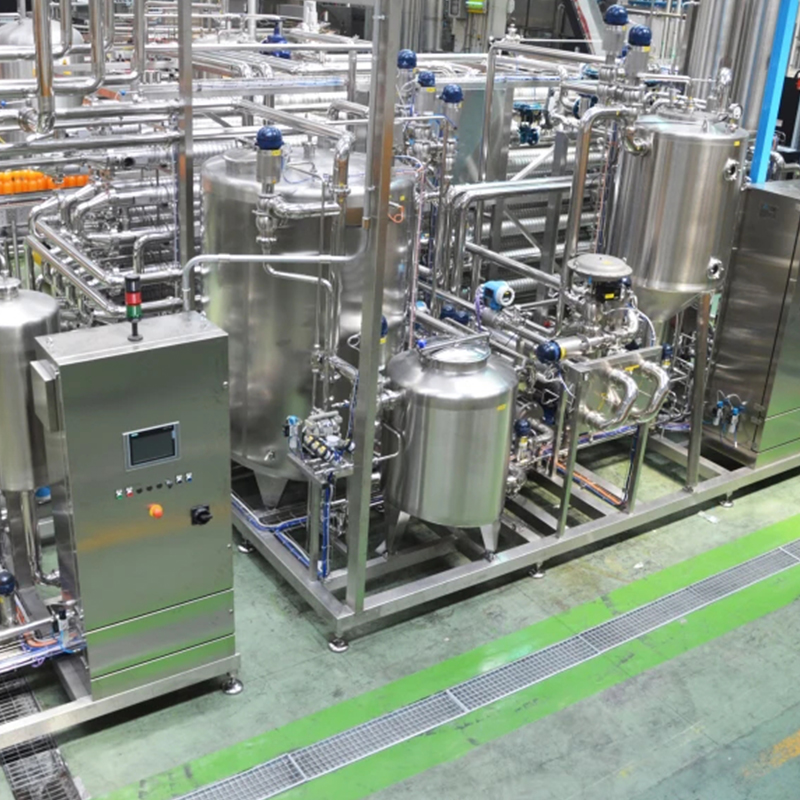
Composants de base de l'équipement
Extracteur à vis : il utilise un arbre à vis pour faire avancer la pulpe de fruit et générer une pression croissante à l'intérieur de la chambre de pressage afin d'assurer la séparation du liquide et des résidus solides. Il se caractérise par un rendement élevé en jus et un fonctionnement stable.
Cuve d'hydrolyse enzymatique : dotée d'un système de chauffage à double enveloppe et d'un dispositif d'agitation à haut cisaillement, cette cuve de réaction permet de contrôler avec précision la température et la durée de la réaction enzymatique, favorisant ainsi la décomposition de la pectine.
Centrifugeuse à disques : elle utilise un ensemble de disques tournant à grande vitesse pour générer un champ de force centrifuge, ce qui permet de séparer rapidement les fines fibres de pulpe de fruit et les particules colloïdales du jus, réduisant ainsi considérablement la turbidité de ce dernier.
Évaporateur à film tombant à effets multiples : il repose sur le principe du transfert thermique en film mince, grâce auquel le jus s'écoule sous forme de film sur la paroi interne du tube de chauffage et s'évapore. Il est généralement associé à la technologie TVR pour récupérer la vapeur secondaire, ce qui permet d'obtenir une concentration à basse température et à haut rendement.
Stérilisateur à très haute température (UHT) : utilise des échangeurs de chaleur tubulaires ou à plaques pour atteindre rapidement la température de stérilisation et refroidir rapidement le jus, ce qui permet de limiter au maximum la destruction des nutriments thermosensibles.
Machine de remplissage aseptique : dans un environnement aseptique, elle remplit de manière dosée des récipients stérilisés avec du jus stérilisé. Elle est généralement équipée d'un système de purge à l'azote afin de réduire la teneur en oxygène résiduel dans l'espace de tête et de prolonger la durée de conservation.
Système de nettoyage CIP : composé de réservoirs de stockage d'acide et d'alcali ainsi que de pompes centrifuges, il nettoie et désinfecte automatiquement l'ensemble du réseau de canalisations et de cuves grâce à un circuit de circulation en boucle fermée, garantissant ainsi l'hygiène et la sécurité alimentaires.