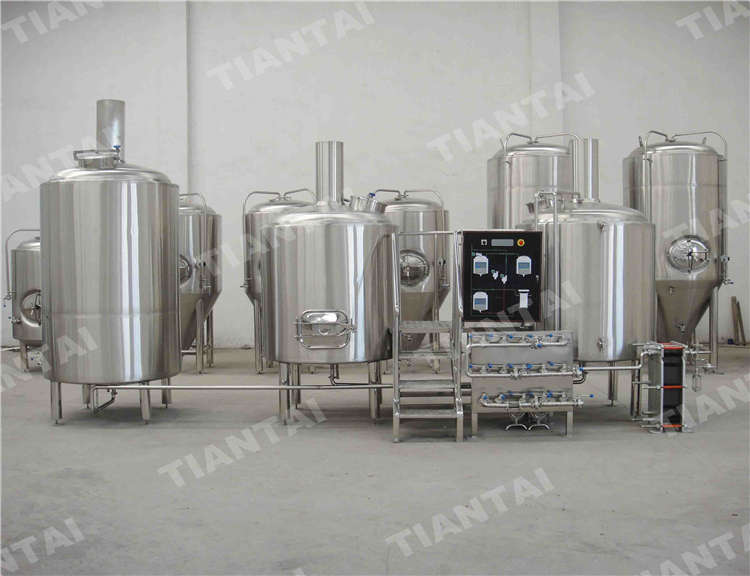
In modern beer production, different types of residues are generated during mashing, fermentation, beer storage, and filling. These residues may include wort, yeast, proteins, and mineral deposits. If they are not removed promptly, they can affect the quality of subsequent batches and increase the risk of microbial contamination.
CIP (Cleaning in Place) is a cleaning technology that allows the internal surfaces of tanks, pipelines, and other production equipment to be cleaned without frequent disassembly.
As brewery production capacity continues to expand, production equipment and piping systems are becoming increasingly complex. Traditional manual cleaning methods can no longer fully meet the requirements of large-scale production lines in terms of cleaning efficiency and hygiene management.
Automated CIP systems use preset cleaning programs to control the delivery, circulation, heating, concentration, and recovery of cleaning solutions. This makes the cleaning process more consistent, standardized, and efficient, making automated CIP systems an essential part of modern breweries.
Key Advantages of Automated CIP Systems
Compared with traditional manual cleaning methods, automated CIP systems improve cleaning efficiency and production hygiene management. Their main advantages include:
Improved Cleaning Efficiency
Automated delivery and circulation of cleaning solutions reduce manual operations and equipment disassembly. This helps shorten cleaning time between production batches and improves equipment utilization.
Consistent Cleaning Performance
The system automatically controls cleaning temperature, duration, flow rate, and cleaning agent concentration according to preset programs. This minimizes variations caused by manual operation and ensures more consistent cleaning results across different equipment.
Reduced Risk of Cross-Contamination
Proper cleaning and sanitization procedures remove organic residues and mineral deposits from equipment surfaces, helping reduce microbial growth and the risk of cross-contamination between production batches.
Reduced Resource Consumption
By circulating, recovering, and reusing cleaning solutions, automated CIP systems can reduce water, cleaning chemical, and heating energy consumption, helping lower the long-term operating costs of breweries.
Main Components of an Automated CIP System
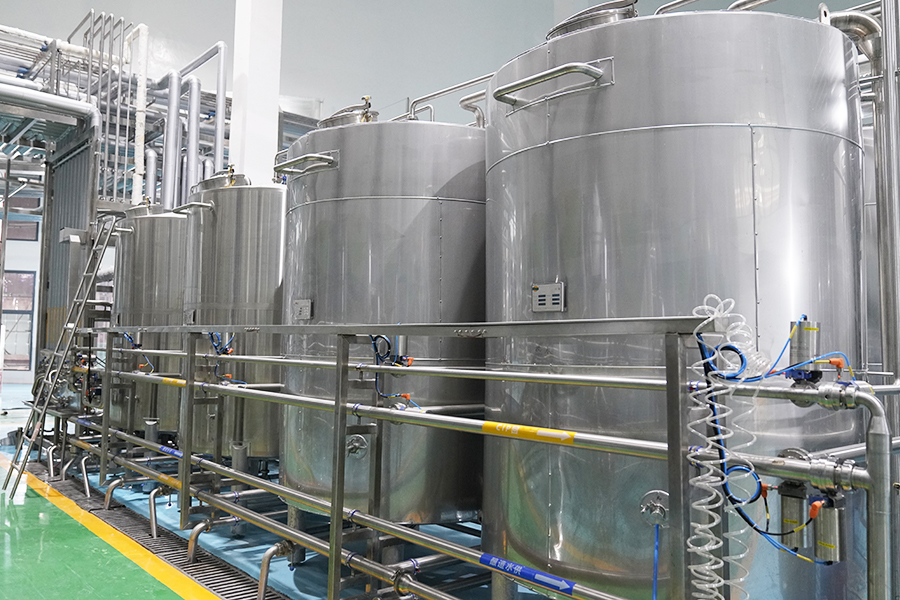
A complete automated CIP system typically consists of cleaning solution tanks, circulation pumps, pipelines and valves, heating equipment, and an automatic control system. These components work together to complete the cleaning process.
CIP Cleaning Solution Tanks
These tanks are used to store clean water, alkaline cleaning solutions, acidic cleaning solutions, and recovered cleaning liquids. Depending on the brewery’s production capacity and cleaning requirements, multiple independent tanks can be configured to support different cleaning procedures.
Circulation Pumps and Piping Systems
Circulation pumps deliver cleaning solutions to the target equipment and establish a complete cleaning loop through supply and return pipelines.
Pump selection should take into account pipeline length, equipment structure, and cleaning requirements to ensure the required flow rate and pressure.
Heating System
Steam heat exchangers and other heating devices are commonly used to raise cleaning solutions to the required process temperature, improving the cleaning performance of chemical agents.
Automatic Valves and Control System
The automated control system uses PLCs, automatic valves, and sensors to monitor temperature, flow rate, pressure, conductivity, and liquid levels.
These components work together to switch cleaning circuits, monitor operating parameters, and execute preset cleaning programs automatically, reducing the need for manual intervention.
Main CIP Cleaning Procedures in Breweries
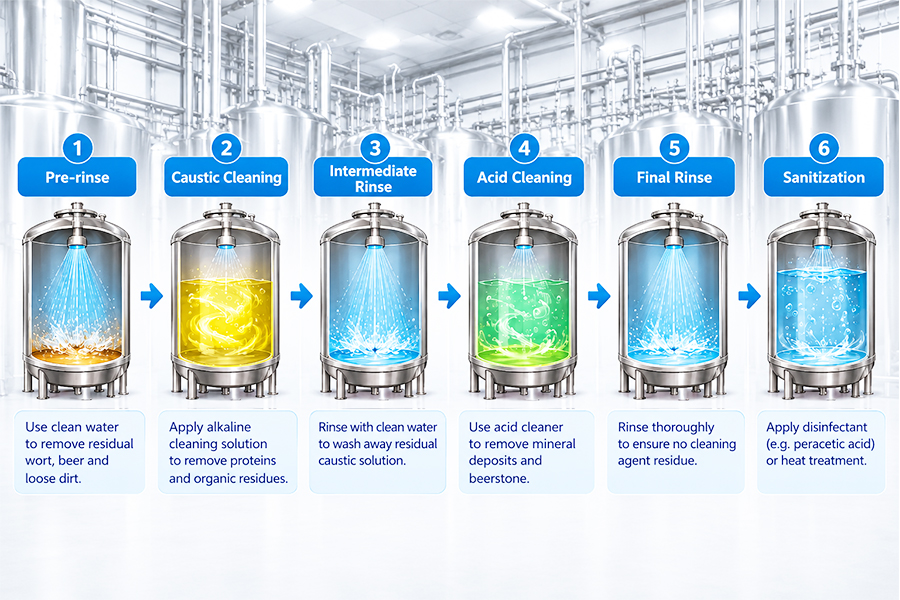
Common CIP cleaning procedures in breweries include pre-rinsing, caustic cleaning, intermediate rinsing, acid cleaning, final rinsing, and sanitization.
The specific cleaning steps should be adjusted according to equipment type, soil conditions, cleaning agent properties, and production hygiene requirements.
Pre-Rinse
Clean water is used to flush the inside of the equipment, removing residual wort, beer, yeast, and other loose contaminants. This helps reduce the soil load before chemical cleaning.
Caustic Cleaning
An alkaline cleaning solution with an appropriate concentration and temperature is circulated through the equipment to remove proteins, yeast, and other organic residues.
Caustic cleaning is one of the most important stages in the CIP process for beer production equipment.
Intermediate Rinse
Clean water is used to flush the equipment and remove residual alkaline solution and loosened contaminants, preventing unnecessary mixing between the alkaline solution and subsequent cleaning agents.
Acid Cleaning
Depending on the degree of scaling, an appropriate acidic cleaning solution is used to remove mineral deposits and beerstone.Acid cleaning is generally scheduled according to the level of mineral buildup and the cleaning cycle. It is not necessarily required during every CIP cycle.
Final Rinse
The equipment is rinsed according to the cleaning agent manufacturer’s requirements to ensure that chemical residues are reduced to the specified control limits.
For no-rinse sanitizers, the manufacturer’s instructions should be followed instead.
Sanitization
According to production hygiene requirements, suitable chemical sanitizers such as peracetic acid may be used. Alternatively, validated hot water or steam treatments can be applied to further control microbial levels on product-contact surfaces.
It is important to understand that cleaning and sanitization are two different processes. Cleaning removes dirt and residues, while sanitization controls microorganisms. Neither process can replace the other.
Applications of CIP Systems in Large-Scale Breweries
Large-scale breweries contain numerous production tanks, transfer pipelines, and heat exchangers. Different production areas have different equipment structures and types of contamination. Therefore, appropriate CIP cleaning circuits should be designed according to the actual production process.
Brewhouse System
Equipment such as mash tuns, lauter tuns, brew kettles, and whirlpool tanks can accumulate wort residues, proteins, and other organic materials.
CIP systems use dedicated spray devices and circulation pipelines to clean the internal surfaces of equipment and associated transfer pipelines, reducing the need for manual cleaning.
Fermentation System
Fermentation tanks can accumulate yeast, proteins, and fermentation residues.Spray balls or rotary spray devices installed at the top of the tanks distribute cleaning solutions across the internal product-contact surfaces, enabling automatic cleaning.
The selection of spray devices should be based on tank structure, required cleaning flow rate, and internal surface coverage.
Bright Beer Tanks and Storage Tanks
Bright beer tanks and storage tanks come into direct contact with finished beer and therefore require strict hygiene control.
CIP systems can clean the internal surfaces of tanks, associated valves, and beer transfer pipelines, helping reduce residue buildup and the risk of microbial contamination.
Beer Transfer Pipelines and Plate Heat Exchangers
Beer transfer pipelines and plate heat exchangers can accumulate beer residues, yeast, proteins, and other contaminants.Circulating cleaning solutions through these systems helps clean their internal flow passages.Proper pipeline layout, drainable design, and suitable cleaning flow velocity are essential for achieving effective CIP performance.
Filling and Packaging Systems
Filling equipment comes into direct contact with finished beer and requires strict hygiene control.For beer-contact pipelines and equipment components designed to support CIP cleaning, dedicated automatic cleaning circuits can be configured.The cleaning scope and procedures should be determined according to the filling equipment structure and the manufacturer’s requirements.
Key Design Considerations for CIP Systems in Large-Scale Breweries
The actual performance of a CIP system depends not only on the cleaning equipment itself but also on factory layout, pipeline design, and cleaning procedures.During brewery project planning, several important factors should be considered.
Proper Cleaning Circuit Design
Cleaning circuits should be divided according to different production areas, including the brewhouse, fermentation, beer storage, and filling systems.The cleaning scope and connections of each piece of equipment should be clearly defined to reduce the risk of cross-contamination between different production areas.
Optimized Pipeline and Equipment Layout
Supply and return pipelines should be properly arranged to minimize unnecessary pipeline length and dead legs.Equipment and pipelines should also be designed for effective drainage to prevent cleaning solution from accumulating inside the system.
Proper Control of Cleaning Parameters
Appropriate cleaning temperature, duration, flow rate, and cleaning agent concentration should be established according to equipment structure and soil characteristics.These parameters help ensure sufficient contact between the cleaning solution and the surfaces requiring cleaning.
Standardized Cleaning Programs
Dedicated cleaning recipes should be established for different types of equipment.Recording key operating parameters during each cleaning cycle also helps verify cleaning performance, improve production management, and optimize cleaning procedures over time.
As brewery production capacity and automation levels continue to increase, CIP systems have become an essential part of maintaining production hygiene and improving equipment utilization in large-scale breweries.
An effective CIP system requires careful planning and integration across the brewhouse, fermentation, beer storage, and filling processes. Key considerations include cleaning circuit configuration, equipment selection, pipeline layout, and automatic control methods.
As a professional beer and beverage equipment manufacturer, Shandong Tiantai Beer Equipment Co., Ltd. can provide customized CIP system configurations and engineering design solutions based on your project scale, production process, and site layout.