
Reverse osmosis (RO) is widely used in beverage production because it reliably removes dissolved salts, bacteria, colloids and high-molecular-weight organics while producing a compact, automated system footprint. RO permeate enables precise recipe control (mineral dosing for style), boiler makeup, and hygienic process utilities.
Effective RO operation depends on robust pretreatment: multimedia (quartz) filters, activated carbon to remove chlorine and organics, fine/security filters (PP cartridge), and targeted antiscalant dosing to protect membranes. Pretreatment should deliver SDI targets and chemistry compatible with the chosen membrane modules.
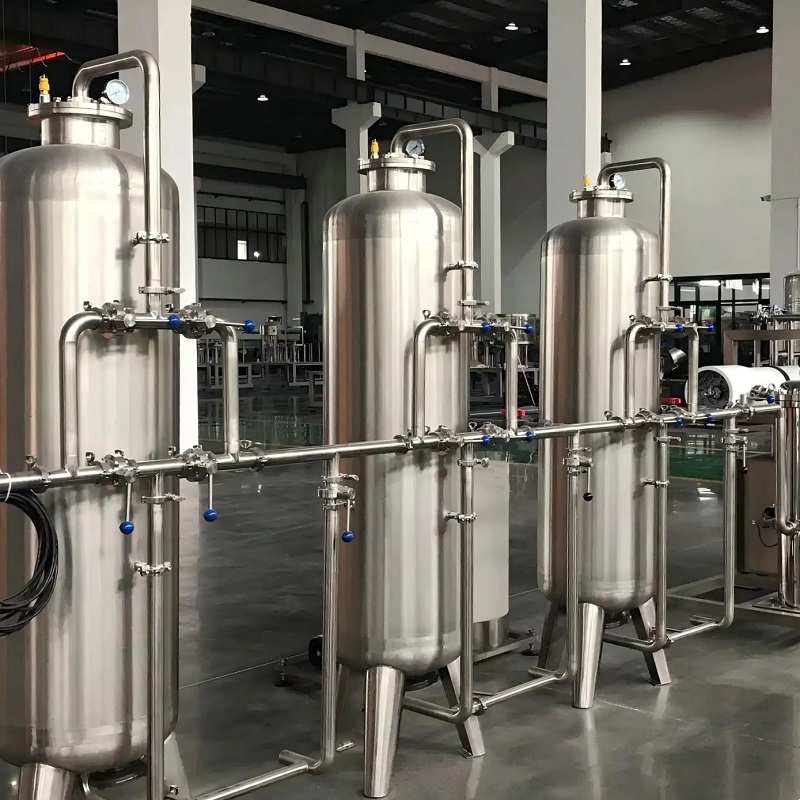
Process parameters (standard / recommended)
- Feed (raw) flow range: 1,000 – 60,000 L/h.
- Permeate (brew water) flow: 500 – 30,000 L/h (dependent on recovery rate and feed quality).
- Feed pressure to RO membrane (high-pressure pump): typically 2 – 17 bar for fresh/brackish RO designs (site-specific).
- Feed temperature: 5–45 °C.
- Feed pH range: 4–9.
Key advantages
- Consistent recipe control: Low-TDS permeate enables precise mineral reconstitution for beer styles and repeatable mash pH.
- Microbial risk reduction: RO removes most bacteria, colloids and high-MW organics when combined with proper pretreatment.
- Compact & modular: Skid-mounted RO systems fit tight plant layouts and scale by adding parallel modules.
- Lower logistics & cost vs cylinders: On-site RO + bulk water reduces reliance on external treated water sources.
Configuration features & build quality
- Raw water buffer tank: Ensures steady feed and decouples supply variations from the pretreatment sequence. 304 SS options available.
- Booster & high-pressure pumps: Sized to overcome pretreatment pressure drops and RO feed setpoint; VFDs recommended for soft start and energy savings.
- Multimedia filtration: Quartz sand or multimedia for particulate removal with automatic backwash cycles; BNR sizing per SDI load.
- Activated carbon stage: Removes free chlorine and organics to protect polyamide membranes.
- Antiscalant dosing: Continuous dosing system with metering pump; typical antiscalant dosages vary by feedwater and chemistry (common practical ranges reported from ~3–20 ppm depending on source and formulation). Pre-quote water analysis required to define dose.
- Security filtration: PP cartridges (1–5 µm) ahead of membranes to catch residual particulates.
- RO membranes & skid: Spiral-wound modules in pressure vessels; construction and material per food-grade compatibility. Membrane selection and staging (single-stage vs two-stage) depend on desired recovery and feed TDS.
- Sanitation & maintenance: Access ports, sampling points, CIP capability for membrane chemical cleaning, and a clear maintenance schedule based on flux and differential pressure.
- Controls: PLC/HMI with conductivity/TDS control loop, automated flush/CIP recipes and alarms for feed/recirculation/backwash events.
Technical specification
- Feed flow range: 1,000 – 60,000 L/h
- Permeate flow range: 500 – 30,000 L/h
- Feed pressure (HP pump): site-dependent; typical 2–17 bar for brackish applications.
- Temperature range: 5–45 °C
- Pretreatment SDI target: ≤ 3–5 (after filters).
- Typical pretreatment: quartz sand → activated carbon → antiscalant dosing → PP cartridge → RO
- Typical antiscalant dose (guideline): consult water analysis; ranges reported ~3–20 mg/L.
- Construction materials: 304 / 316 stainless steel piping & tanks; food-grade pumps and fittings
Installation & operational notes
- Water analysis first: Always supply a full feedwater analysis (TDS, hardness, alkalinity, silica, Fe, Mn, SDI, organics) before finalizing membrane type and recovery targets.
- Design recovery conservatively: Higher recoveries increase scaling risk; balance recovery against antiscalant strategy and discharge constraints.
- SDI control: Install SDI test point upstream of RO to validate pretreatment performance; target SDI ≤5 (ideally ≤3 for sensitive modules).
- Antiscalant selection: Use supplier-recommended chemistries and dosing calculators during commissioning to set baseline rates.
- CIP & cleaning: Plan for periodic chemical cleanings (CIP) based on differential pressure and permeate decline; maintain spare cartridges and membrane element inventory.