Production Line Introduction
The Single Malt Whisky Production Line is a comprehensive brewing system encompassing the entire process from malt handling to oak cask maturation. Its defining characteristics are twofold: it utilizes 100% malted barley as its raw material, and the entire production process is completed within a single distillery.
The production line offered by Tiantai Company adheres to traditional Scottish pot-still distillation techniques while integrating modern automation and energy-saving technologies. The line is adaptable to varying production capacities—ranging from small-scale artisanal distilleries to large-scale facilities producing millions of liters annually—and offers optional features such as high-speed maturation systems, self-cleaning filtration units, and energy recovery modules. These options are designed to meet the dual demands of the modern spirits market for both efficiency and quality.

Process Description
The production of single malt whisky encompasses five core stages, each of which exerts a decisive influence on the final flavor profile.
1. Malt Handling and Mashing
Raw Material Selection: Typically, two-row malted barley is used; however, some distilleries opt for barley from specific geographic regions to impart distinct regional characteristics. The malt may also undergo peat smoking to infuse it with phenolic flavors.
Milling and Mashing: The malt is ground into a “grist” (coarse flour) using a roller mill; this grist consists of a mixture of coarse particles, fine flour, and husks.
The grist is mixed with hot water in a mash tun. Through a multi-stage hot water extraction process, fermentable sugars are leached out to produce a liquid known as “wort.”
Modern distilleries may utilize dynamic wort filtration systems as an alternative to traditional mash tuns; these systems enable higher extract yields and facilitate energy-efficient cold-water rinsing processes.
2. Fermentation
After cooling, the wort is pumped into fermentation tank, where distiller’s yeast is added to initiate alcoholic fermentation.
The fermentation cycle typically lasts 48 to 72 hours, yielding a “wash” (fermented liquid) with an alcohol content of approximately 7% to 9% ABV. Some distilleries employ temperature-controlled fermentation vessels to ensure consistent flavor production. The fermentation vessels are constructed from stainless steel, facilitating easy cleaning and temperature regulation.
3. Distillation
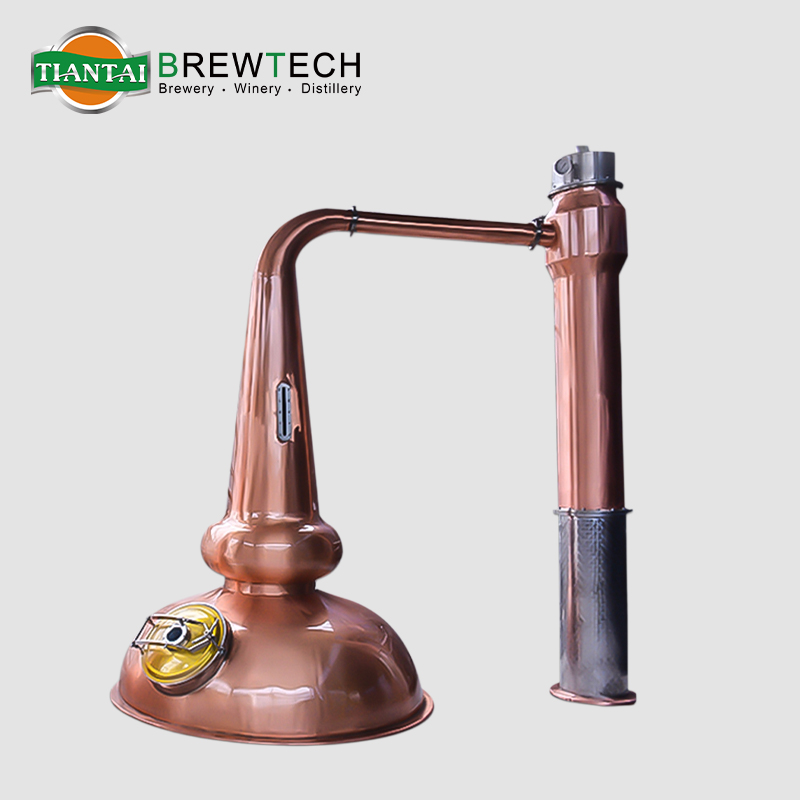
Distillation is the pivotal stage—the very soul of the process—that shapes the body and stylistic character of the single malt whisky. Core Equipment: Copper Pot Stills
Whisky distillation utilizes a pair of pot stills,a wash still and a spirit still—constructed from copper. This material serves to remove undesirable flavor compounds, such as sulfides.
First Distillation: The fermented liquid is charged into the wash still, yielding a “low wine” with an alcohol content of approximately 25%–30%.
Second Distillation: The low wine enters the spirit still for rectification. During this process, the “heads” and “tails” are cut away, retaining only the “heart”, with the alcohol content controlled within the range of 50%–70%.
Key Influencing Factors:
Still Shape: Tall, slender stills—due to their strong reflux action—produce a lighter-bodied spirit with prominent floral and fruity notes; short, stout stills yield a heavier-bodied spirit with more robust flavors.
Lyne Arm Angle: Influences the direction of the vapor flow and the efficiency of condensation.
Condenser Type: Shell-and-tube condensers produce a cleaner, lighter-bodied spirit; traditional worm tub condensers retain more sulfur compounds, resulting in a heavier-bodied spirit.
4. Oak Barrel Aging
Cask Filling: The colorless, transparent new spirit is diluted with water to an alcohol content of approximately 63.5% before being filled into oak casks.
Maturation Environment: The warehouse environment requires strict control over temperature and humidity.
Oak Barrel Type: Over 60% of the final flavor profile is derived from the Oak Barrel themselves.
Common choices include:
Sherry Casks: Impart flavors of dried fruit, chocolate, and dark fruits.
Bourbon Casks: Impart flavors of vanilla, coconut, and honey.
Wine/Fortified Wine Casks: Such as Sauternes, Port, or Red Wine casks; these are often used for “finishing” (secondary maturation) to add complexity to the spirit.
Accelerated Maturation Technology: Some modern production lines employ pressure-assisted maturation systems. By utilizing high temperature and pressure to accelerate the extraction of compounds from the wood, these systems can simulate the flavor characteristics typically achieved through years of traditional maturation within just 30 days.
5. Blending and Bottling
Once maturation is complete, the Master Blender blends spirits from various cask types and vintages.
Prior to bottling, a choice is made between chill filtration and non-chill filtration . The product is typically bottled at an alcohol strength of 40%–50% ABV, while select cask-strength products may reach 50%–60% ABV.
Basic Equipment Components
A complete single malt whisky production line consists of five major modules, covering the entire process from raw material handling to finished product storage.
Raw Material Handling & Milling Module:Malt storage silos, magnetic separators, roller mills, and malt conveying systems. This module ensures precise control over grist particle size while maintaining the integrity of the husks to facilitate efficient mashing and filtration; it is adaptable for switching between peated and unpeated malts.
Mashing & Fermentation Module:Mash tun, wort plate heat exchanger, fermentation vessels, and temperature-controlled jackets. A multi-stage mashing extraction process ensures a high yield of extractable sugars; the fermentation vessels are equipped with an automatic temperature regulation system to prevent deviations from the optimal temperature range for yeast activity.
Distillation Module :Copper pot still assembly, shell-and-tube or worm tub condensers, foreshots and feints collection tanks, and spirit safes. The use of red copper promotes the formation of aromatic esters and facilitates the removal of sulfur compounds; the specific shape of the stills and the design of the lyne arms determine the stylistic profile of the resulting spirit.
Maturation Module:Oak casks (Bourbon, Sherry, or Wine casks), large horizontal stainless steel storage tanks , temperature- and humidity-controlled warehouses, and liquid transfer systems. This module supports the co-storage of various cask types as well as re-casking processes; the stainless steel tanks can be equipped with an inert gas blanketing system to prevent oxidation.
Post-Processing & Filtration Module:Bag filters or self-cleaning filters, cooling units, and bottling lines.