
Cold water (often called cold liquor in brewery operations) is a critical utility. It is used to cool wort after the kettle, keep centrifuges operating efficiently, supply pasteurizers with low-temperature water, and support any process that requires chilled water.
Rather than relying solely on direct chiller outputs or glycol loops in contact with process lines, this system delivers dedicated cold water at controlled temperature and pressure so your brewery equipment runs reliably and consistently.
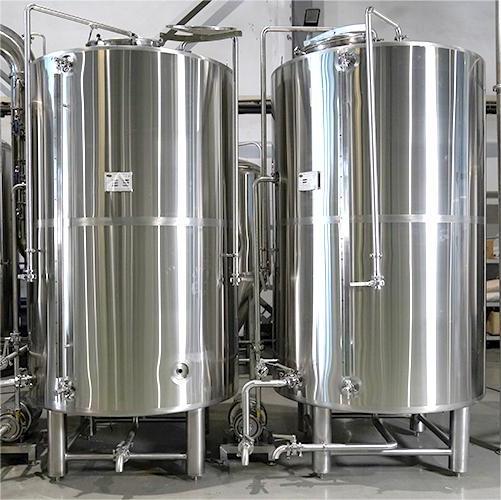
Process Parameters
Supply temperature (target): 1–3 °C (site and process dependent).
Supply pressure (typical): 3–4 bar at point of use (use VFD + pressure sensor to maintain constant outlet pressure).
Tank sizing: reserve buffering capacity to cover peak wort cooling demand (common practice: CLT sized to cover one brew’s point load plus margin).
Key Advantages
Peaks handled by storage: Buffering reduces required chiller peak capacity and smooths electrical demand.
Food-safe option: Using cold water (rather than circulating glycol directly where leaks could contact wort) lowers contamination risk while permitting glycol as the chiller loop where needed.
High heat-transfer efficiency: Plate heat exchangers paired with cold-liquor tanks achieve fast wort knockouts and improve energy recovery when hot liquor is reused.
Operational flexibility: Modular exchangers and pump staging let the system scale from pilot to production lines.
Configuration Features & Build Quality
Materials: Food-grade 304 (or 316 where required) stainless steel construction for tanks and piping; sanitary tri-clamps and sight/glass sampling ports.
CIP readiness: Top-mounted manholes and high-reach rotary spray ball(s) to avoid dead-legs and maintain hygiene.
Cooling options: Plate heat exchanger (PHE) primary cooling; optional coil or dimple jacket within the tank for direct cooling or recirculation cooling loops.
Insulation: Single or double-skinned with PU insulation depending on ambient heat load; choose insulated tanks in warm plants to reduce refrigeration duty.
Controls: VFD pumps with downstream pressure sensor for isobaric supply, PLC/HMI recipes for recirculation/CIP, temp/level alarms and remote telemetry as required.
Technical Specification
Target supply temp: 1–3 °C.
Typical supply pressure: 3–4 bar (adjust per site).
Common tank capacities: pilot (hundreds of L) → production (thousands to 10,000s L) — size per peak point load.
Heat exchanger types: gasketed plate PHE, welded PHE, coil/dimple jacket.
Chiller types: glycol chiller (propylene glycol for food safety) or direct chilled-water plant.
Installation & Operational Notes
Size the cold liquor tank to meet instantaneous cooling demand (one brew or defined peak) plus margin; buffer tanks reduce chiller sizing and peak power draw.
Place cold liquor tank away from heat sources; use insulation or active refrigeration in hot climates to keep tank at target temp.
Implement VFD pressure control downstream of backflow protection and include isolation valves for maintenance.
Where wort contact is possible, keep secondary refrigerant (glycol) confined to a closed loop; prefer cold-water process loops where leakage would compromise product.