
Yeast propagation reduces reliance on external suppliers and preserves strain purity and performance. The system supports stepwise propagation from lab inocula (Carlsberg flasks / Hansen tanks) into production propagators, with controlled aeration, temperature and agitation to reach the target cell mass for pitching. Proven skid solutions are available for craft-scale up to industrial production—with integrated CIP and sterile air handling for aseptic operation.
Process design separates sterile wort preparation, aerobic propagation and cold storage to minimize contamination risk. Inline sampling and batch logging provide the traceability required by QA teams.
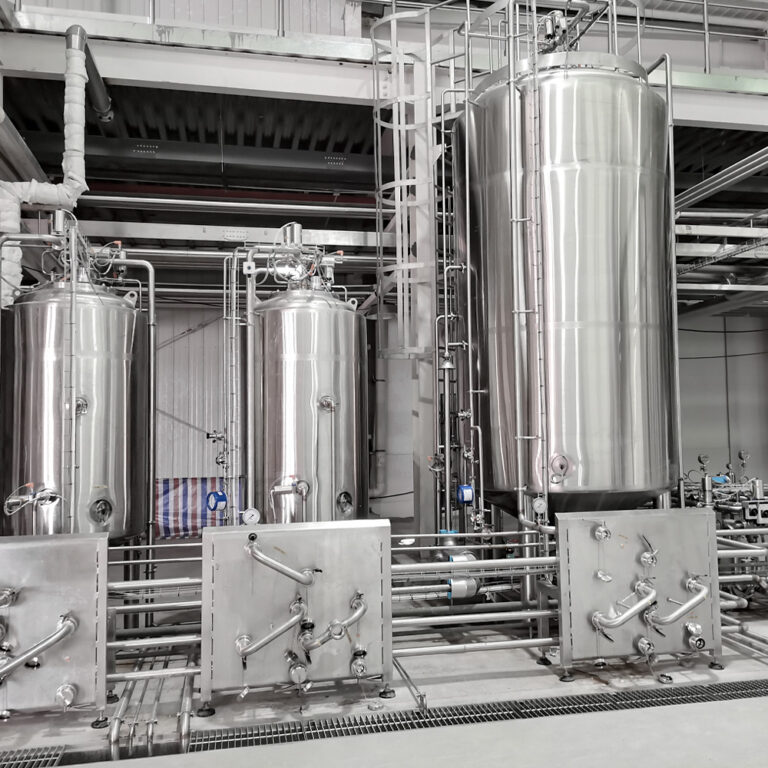
Key features
- Hygienic surface grades: mirror/hygienic finishes (Ra options down to ≤0.2 µm available from suppliers; common hygienic guidance often cites ≤0.8 µm as a baseline).
- Full CIP + SIP capability: all product piping and vessels designed for CIP; steam-in-place for sterilization where required.
- Sterile gas handling: sterile filters for aeration/vent lines (0.2 µm gas filters available for microbial control).
- Traceability & control: PLC/HMI with recipe management, batch logging and QA export (OPC/Modbus integration).
- Scale-flexible: modular skid options for craft, mid-size and production breweries.
Configuration & build quality
- Material: 304 SS standard; 316L optional for aggressive chemistries.
- Welding & finish: automated TIG welding, mechanical polishing, pickling/passivation; welds blended to hygienic profiles.
- Cleaning: CIP circuits sized for propagator geometry; high-efficiency 360° spray balls for coverage.
- Controls: PLC/HMI with strain recipes, alarms, DO/temperature control and sampling logs.
- Air handling: sterile filters and sterilizable air lines; provision for steam-sterilizable vents.
- Inner surface finish: suppliers offer polished finishes; propagators can be specified with inner Ra targets (≤0.2–0.4 µm achievable for high-hygiene equipment). Industry guidance notes that the finish choice should match CIP validation and risk analysis.
- All product contact piping and fittings are sanitary (tri-clamp, smooth bore), with no dead-legs and full CIP return routing.
- Steam purge and SIP cycles are supported on tanks and sterile air lines; sterile gas filtration (0.2 µm) protects aeration loops.
Technical specification
- Typical propagator volumes: pilot (50–500 L) → plant (1,000–10,000+ L) (configurable)
- Internal finish: specify Ra target (≤0.2–0.8 µm depending on hygiene spec)
- Sterilization: CIP + optional SIP (steam-sterilizable ports & lines)
- Controls: PLC/HMI, data logging, fieldbus options
- QA: sterile sampling ports, cell-count sampling, DO and temperature monitoring
Installation & operational notes
- Dedicated sterile lines from the lab to the propagator reduce cross-contamination risk.
- Validate CIP/SIP cycles on site; include recovery routing for CIP waste.
- Provide strain-specific SOPs and QC sampling points (cell counts, viability, contamination checks).
- For carbonated or clarified media, ensure sampling and transfer ports prevent foaming and shear damage.