
The hot water supply is central to soaking, mashing, sparging, cleaning and other thermal processes. This system supplies controlled hot liquor, recovers waste heat from wort coolers and condensate, and integrates with RO/DI or dosing skids for recipe-driven temperature control.
Designed for scale: modular tank sizes, optional pump redundancy and industrial control packages allow deployment in microbreweries, brewpubs, medium plants and large production facilities.
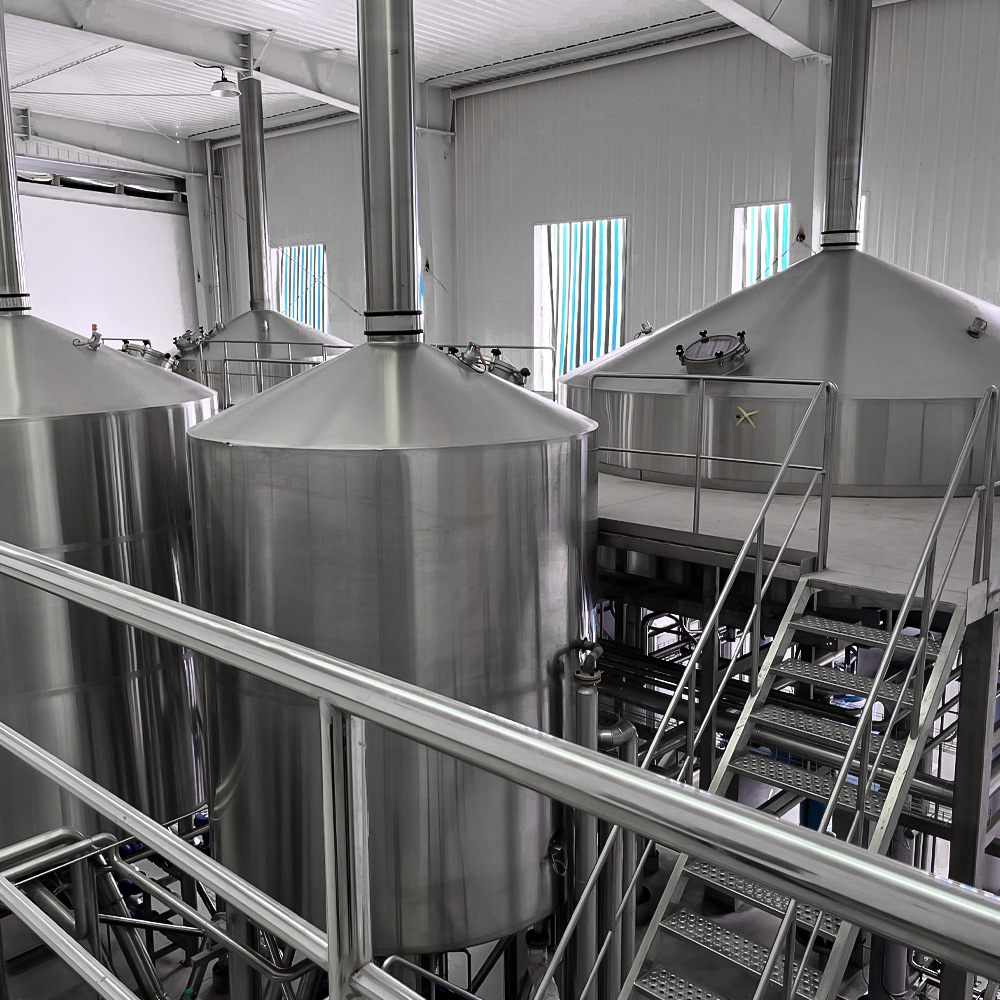
Process parameters
- Typical supply temperature: 82–85 °C (adjustable per recipe)
- Typical supply pressure: 3–4 bar (VFD/isobaric control); higher setpoints possible for distribution manifolds
- Pressure sensor + VFD pump staging; temperature control via heat exchanger or jacketed HLT
Key features
- Flexible heating methods: Plate heat exchangers, steam jackets, internal coils, or direct steam injection configured per site and energy availability.
- Heat recovery: Capture heat from wort cooling and steam condensate via exchangers to pre-heat make-up water and reduce energy demand.
- Isobaric supply: VFD or pressure-sensing centrifugal pump ensures constant outlet pressure for consistent mash/sparge performance and cleaning flows.
- Hygienic design: CIP-ready internal geometry, polished surfaces and no-dead-leg piping reduce contamination risk and speed turnaround.
- Scalable reliability: N+1 pump redundancy, industrial motor-reducers and control interlocks for continuous operation in production environments.
Detailed configuration & build quality
- Materials: Food-grade 304 SS standard; 316L option for aggressive chemistries or required spec compliance.
- Surface finish & welding: Automated welding, multi-stage mechanical polishing and pickling/passivation; internal finish ≤ 0.4 µm standard.
- CIP engineering: Optimized spray pattern using high-reach rotary spray ball(s); porting supports multi-tank automated cycles and CIP recovery routing.
- Valves & actuators: Sanitary butterfly, angle-seat and diaphragm valves with robust cores specified for thermal and chemical cycling.
- Insulation: Polyurethane thermal insulation for jacketed or insulated tanks to minimize heat loss.
Technical specification
- Tank material: 304 SS (316L optional)
- Internal finish: ≤ 0.4 µm (polished, pickled/passivated)
- Supply temp: 82–85 °C (standard)
- Supply pressure: 0–6 bar (recommended 3–4 bar)
- Insulation: polyurethane or alternative on request
- Cleaning: automatic CIP with rotary spray ball(s)
- Controls: temp, pressure, level, flow; VFD pump control; PLC/HMI options
- Heat recovery: plate or shell-and-tube heat exchangers; condensate recovery skids available
Installation & operational notes
- Design heat-recovery routing to feed make-up water or pre-heat HLT via dedicated exchangers; provide bypass for maintenance.
- Place pressure sensors downstream of backflow prevention devices to ensure accurate VFD control.
- Provide CIP return and recovery lines to wastewater treatment or recirculation systems to reduce discharge volume.
- Specify fieldbus/Modbus/OPC interfaces for integration with plant EMS and recipe management.