
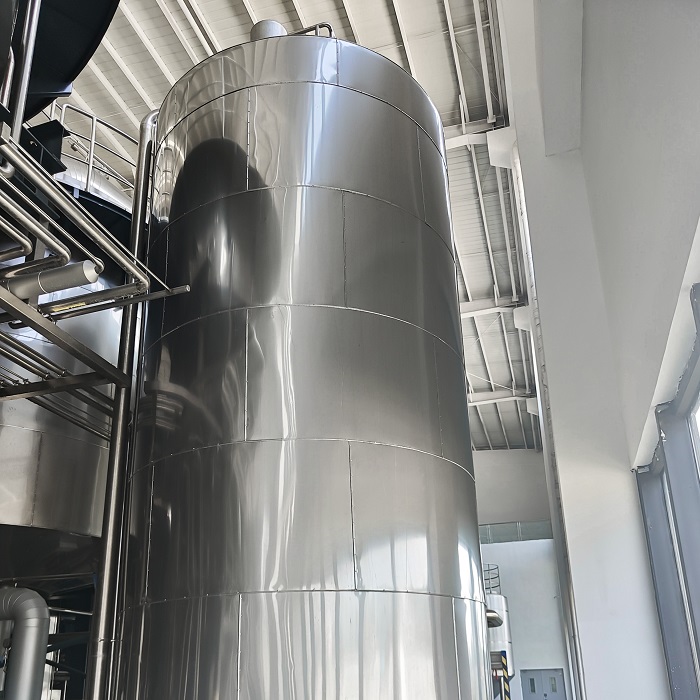
Water chemistry and supply stability directly affect mash pH, enzyme performance, yeast health and finished beer clarity and taste. This tank delivers process-ready water—treated, sampled and supplied at controlled pressure—to support kettle fills, sparging, yeast propagation and ancillary utilities across brewery sizes.
Built for scale: modular connections, optional pump redundancy and industrial-rated components let the same design serve a microbrewery pilot line or be deployed as a production feed in medium and large breweries.
Process parameters
- Supply temperature: ambient (room temperature); heating jackets optional
- Typical supply pressure: 3–4 bar (adjustable per site). Larger distribution may require higher setpoints—specify at quotation.
- Control: pressure sensor + VFD pump (single or multi-pump staging) for constant outlet pressure and soft-start protection
Key advantages
- Process stability at any scale: VFD pressure control and pump staging ensure steady outlet pressure for consistent sparge and transfer rates.
- Hygienic operation: Polished internal surfaces, automated CIP and no-dead-leg piping reduce contamination risk and shorten cleaning cycles.
- Scalable integration: Modular ports and connection flanges support inline RO/DI, mineral dosing skids, heat exchangers, and multi-zone distribution.
- Reliability for production plants: Options for redundant pumps, industrial motor-reducers, and control interlocks minimize downtime in medium/large operations.
- Customization: Multiple capacities, jacketed/heated options, and control integration for SCADA or plant EMS.
Detailed configuration & build quality
- Material: 304 stainless steel plates for corrosion resistance and brewery-grade durability; 316 available on request for aggressive chemistries.
- Surface finish & welding: Automated welding with multi-stage mechanical polishing and pickling/passivation; internal finish ≤ 0.4 µm standard.
- Sanitary design: No-dead-leg piping runs, tri-clamp fittings, sanitary sight glasses and accessible sampling ports.
- CIP design: Engineered spray pattern using high-reach rotary spray ball(s) sized to eliminate dead zones; CIP porting supports multi-tank automated programs.
- Valves & actuators: Industrial valve options with hygienic actuators; materials chosen for chemical and thermal resilience.
- Drive & motors: Industrial motor-reducer units from recognized manufacturers; optional VFDs with pump-protection logic.
- Insulation: Polyurethane thermal insulation (≈40 kg/m³) or alternative insulation systems for jacketed/temperature-controlled units.
- Controls & integration: PLC/HMI packages with recipes, alarms and fieldbus/OPC/Modbus/Profinet integration available for enterprise control systems.
Technical specification
- Tank material: 304 SS (316 optional)
- Internal finish: ≤ 0.4 µm (polished, pickled/passivated)
- Typical pressure range: 0–6 bar (customizable)
- Temperature: ambient supply; jacketed/heated options available
- Insulation: polyurethane (~40 kg/m³)
- Cleaning: automatic CIP with rotary spray ball(s)
- Controls: pressure sensor, level probe, temperature sensors, VFD pump control, PLC/HMI options
- Capacities: pilot sizes (100–1,000 L), production sizes (1,000–20,000+ L) — custom fabrication on request
Installation & operational notes
- Provide pump redundancy (N+1) and staged control for uninterrupted feed to production lines.
- Integrate return/CIP recovery and wastewater routing to minimize discharge and comply with site wastewater handling.
- Locate pressure sensors downstream of backflow devices for accurate VFD control; provide isolation valves for maintenance.
- Include sanitary sampling ports and an accessible instrument rack for routine water quality checks and dosing point control.
- Specify connections for upstream treatment (RO/DI) and downstream distribution manifolds when designing plant layout.