
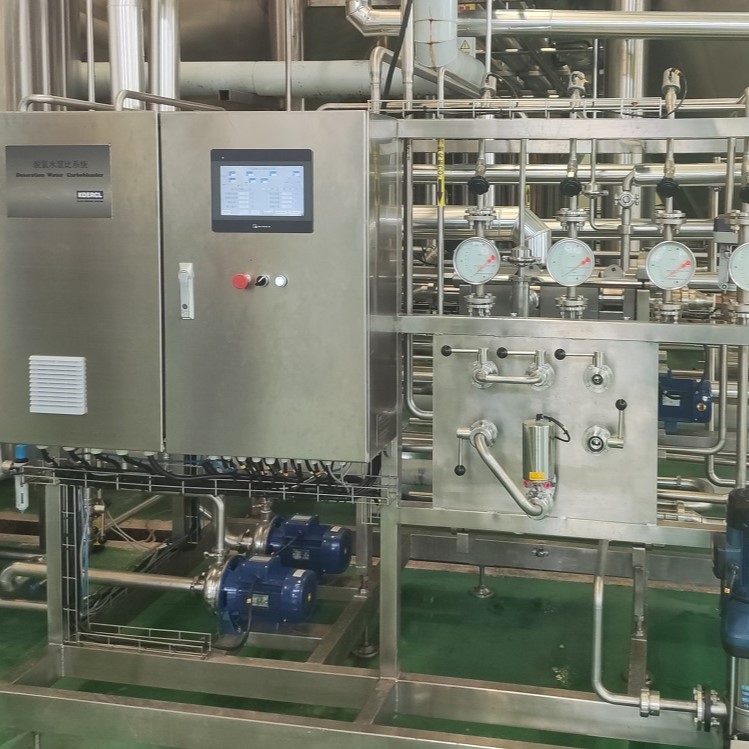
This module controls dilution by continuously regulating water flow against beer flow using high-accuracy flowmeters and density feedback. The cascade PID architecture stabilizes concentration while maintaining volumetric traceability—important for production consistency and audit records.
Designed as a drop-in skid, the unit supports integration with upstream RO/DI, dosing skids and downstream distribution manifolds. Options include pump redundancy (N+1), heated/jacketed mixers, and PLC/HMI or SCADA/OPC integration for enterprise control.
Process parameters
- Mixer capacity (dilution machine): 60 m³/h
- Mixing accuracy (volume): ±0.2ºP
- CO₂ in beer after dilution (mass fraction): 0.4–0.6% (m/m) — typically controlled and verified at the packaging/filling stage; specify target per product.
Key features
- High-accuracy metering: Hygienic flowmeters measure mass, volume and density for precise ratio control and batch records.
- Fine-tuning proportion program: Soft micro-step adjustments prevent valve hammer and instrument wear during small corrections.
- Hygienic, CIP-compatible design: No-dead-leg piping, sanitary fittings and dedicated CIP ports for effective cleaning.
- Production reliability: Options for N+1 pump redundancy, pump staging, and industrial drives for minimal downtime.
Configuration features
- Flow & ratio control loop: Electromagnetic or Coriolis flowmeters feed the PLC; a regulating valve on the water line (and proportioning pump) is modulated to achieve the preset beer:water ratio.
- Density primary loop: Inline density sensor provides real-time concentration (°Plato/density) to a primary PID; that PID sets the cascade setpoint for the water-flow controller. Coriolis meters can simultaneously supply mass flow and density for consolidated control.
- Fine-tuning & anti-vibration logic: Implement slew-rate limits, anti-windup and micro-step proportioning to avoid aggressive valve movement and protect instruments on large systems.
- Redundant control modes: If a density sensor or flowmeter falls outside tolerance, the system can fail over to the alternate control mode (volume ↔ concentration) while logging the event and raising alarms for operator action.
Detailed configuration & build quality
- Materials: Sanitary 304 SS construction standard; 316 SS available for aggressive chemistries or client spec.
- Surface finish & welding: Automated welding with mechanical polishing and pickling/passivation; internal finish ≤ 0.4 µm where required for hygiene.
- Sanitary design: Tri-clamp fittings, sample points, and CIP spray coverage to avoid dead zones.
- Control hardware: PLC/HMI packages with recipe management, trending and alarm handling; fieldbus options for plant integration.
- Mechanical robustness: Industrial motor-reducers, sanitary pumps and actuators sized for continuous duty; N+1 configurations for production plants.
Technical specification
- Mixer capacity: 60 m³/h
- Mixing accuracy: ±0.2ºP (volume)
- CO₂ after dilution: 0.4–0.6% (m/m) (confirm per product).
- Measurement hardware: Coriolis or high-accuracy electromagnetic flowmeters; an inline density sensor
- Control: cascade PID (density → flow), PLC/HMI, data logging
- Sanitation: full CIP porting, no-dead-leg design, sample ports
Installation & operational notes
- Place density sensor and Coriolis meters upstream of any large degassing sections; if incoming product is carbonated, add degassing or headspace control ahead of density measurement.
- For production reliability, specify pump redundancy and staged control for uninterrupted feed to packaging or bright tanks.
- Provide CIP return routing and wastewater handling to match plant utilities and reduce cross-contamination risk.