
Brewing requires stringent cleaning protocols: microscopic contamination can spoil an entire batch. This CIP solution provides section-specific cleaning programs (brewhouse, fermentation/brite tanks, transfer lines, filling plant) using controlled alkali, acid and disinfectant cycles with validated temperatures, concentrations and flow rates.
The system supports isolated loops per production section, automated recipe execution via PLC/HMI, and engineered hydraulics (high-lift pumps, low-resistance piping) to guarantee effective cleaning at tank and pipeline endpoints.
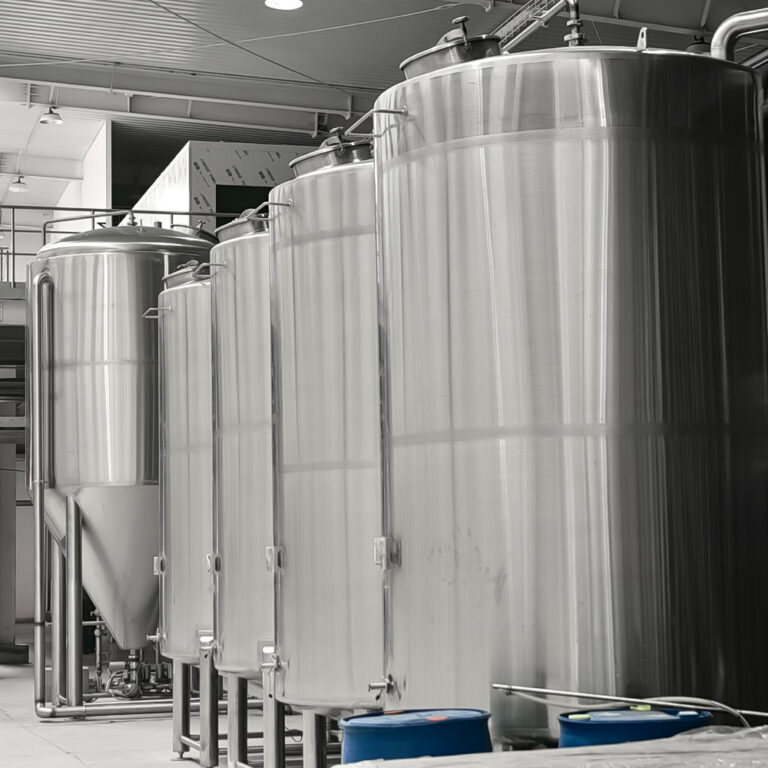
Process parameters
- Brewhouse CIP alkali temperature: 60–70 °C
- Fermentation & brite tanks CIP temperature: 40–45 °C
- Alkali concentration: 2–4% (typical)
- Acid concentration: 1% (typical)
- Disinfectant concentration: 0.5–1% (typical)
- Cleaning fluid flow rate for tanks: > 20–35 L/min
- Cleaning fluid flow velocity for pipelines: > 1–1.5 m/s
- Heating: plate & frame heat exchanger to meet temperature ramp and hold profiles
Key features & benefits
- Sectional isolation: Dedicated CIP loops for brewhouse, cellar and filling reduce cross-contamination and allow parallel cleaning.
- Automated recipes: PLC/HMI executes timed cycles, concentration dosing, temperature holds and rinse sequencing; logs results for QA.
- Engineered hydraulics: High-lift pump design and low-resistance piping maintain the required pressure at endpoint cleaning devices for validated cleaning intensity.
- Thermal control & recovery: Plate heat exchanger provides rapid heating; integration with plant heat recovery reduces energy demand.
- Validated chemistry control: pH and conductivity monitoring support accurate dosing and endpoint verification.
- Hygienic construction: 304/316 stainless steel, polished internals (≤ 0.4 µm), no-dead-leg piping and sanitary fittings minimize bioburden risk.
- Rapid turnaround: Optimized spray coverage and automated cycles shorten downtime between batches.
- Scalable reliability: Modular pump staging, redundancy options and enterprise control integration for continuous production.
Detailed configuration & build quality
- Materials: Standard 304 SS; 316L option for aggressive chemistries or specific site requirements.
- Welds & finishes: Automated welding, multi-stage mechanical polishing, pickling and passivation; internal finish ≤ 0.4 µm.
- Valves & actuators: Sanitary valve selection with high-quality valve cores rated for acid/alkali and thermal cycling.
- Pumps: High-lift centrifugal or plunger CIP pumps sized to achieve nozzle/line endpoint pressure and required flow velocities; VFD control available.
- Heat transfer: Plate & frame heat exchangers sized for rapid heat-up and hold; bypass and recirculation lines for precise control.
- Instrumentation: Level switches, flowmeters, pressure transducers, temperature probes and inline pH/control sensors with remote alarm capability.
- Automation: PLC recipe library, HMI operator screens, remote access and optional MES/SCADA integration via Modbus/OPC/Profinet.
Technical specification
- Tank materials: 304 SS (316L optional)
- Internal finish: ≤ 0.4 µm (polished, pickled/passivated)
- Alkali wash temp: 60–70 °C (brewhouse); 40–45 °C (fermenter/brite)
- Alkali concentration: 2–4% | Acid: ~1% | Disinfectant: 0.5–1%
- Tank flow rate: > 20–35 L/min | Pipeline velocity: > 1–1.5 m/s
- Heating: plate & frame heat exchanger standard
- Controls: PLC/HMI, sensors (temp/flow/level/pH), recipe logging
- Capacity: modular tanks sized to match section volume and recovery strategy
Installation & operational notes
- Size hot alkali and sterile water tanks to match the largest section CIP volume and desired cycle frequency.
- Route sensors and sample ports to instrument racks for easy QA sampling and calibration.
- Place pressure/flow sensors downstream of backflow prevention devices for accurate measurement.
- Provide CIP return and wastewater routing with recovery or holding tanks to meet site effluent requirements.
- Design spray ball/nozzle placement and pump sizing per tank geometry for validated coverage; verify nozzle reach during FAT/SAT.
- Integrate heat recovery where possible (e.g., pre-heat make-up water from wort cooler condensate) to improve energy efficiency.