Have you ever wondered how the glass bottle in your hand came to be? This seemingly simple container endures 1,500°C of molten heat, precise industrial forming, and rigorous quality control before becoming part of your brewery’s packaging line.
In this article, we take you inside a modern beer bottle production line to explore how raw materials, chemistry, and technology combine to produce the perfect beer container.
Anatomy of a Beer Bottle & Its Raw Material Formula
Every beer bottle follows a carefully engineered structure: the finish, neck, shoulder, body, and base — each with specific strength and functional requirements.
Label zones typically include the neck, body, back, and footer, striking a balance between marketing design and ergonomic handling.
The main ingredient in glass is silica (SiO₂), a natural sand-based material. To lower the melting temperature and improve workability, soda ash (Na₂CO₃) and limestone (CaCO₃) are added.
Up to 90% of the batch may be composed of cullet (recycled glass). This crucial sustainability factor reduces furnace energy consumption, CO₂ emissions, and melting time while maintaining glass quality and consistency.
The Science of Color: How Beer Bottle Colors Are Made
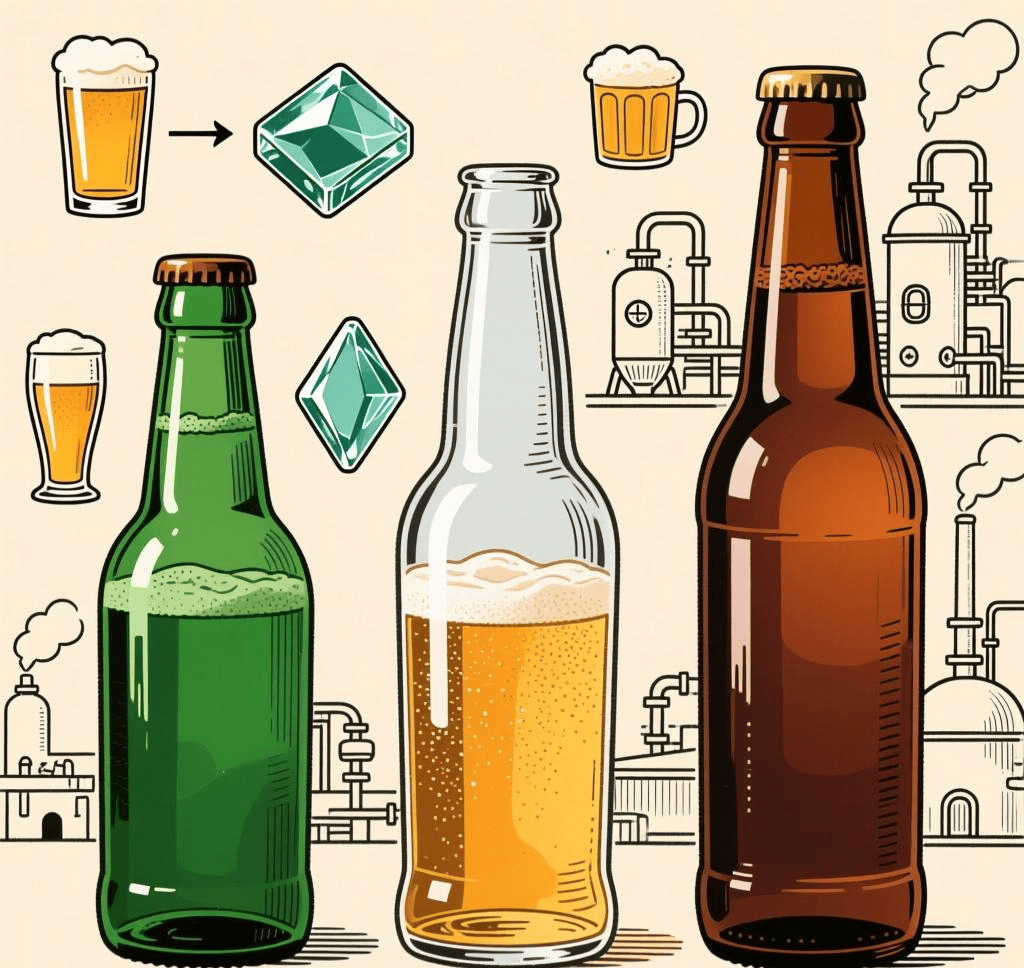
The signature colors of glass bottles are achieved by adding trace amounts of metal oxides during melting. These not only influence aesthetics but also serve a protective function:
-
Flint (Clear): No colorant, ideal for products emphasizing transparency and purity.
-
Green: Derived from iron compounds; commonly used for wine and specialty beverages.
-
Brown (Amber): Produced with chromium oxide, providing UV light protection to prevent beer from becoming light-struck.
-
Blue: Created by adding cobalt, often chosen for limited-edition or premium packaging.
Core Manufacturing Process: From Molten Glass to Bottle Form
1. Batch Preparation and Melting
In the glass factory, raw materials are precisely weighed, blended, and fed into a regenerative furnace operating at around 1,500°C. Inside, the batch melts into homogeneous molten glass, which passes through a refining zone to remove air bubbles and impurities.
2. Gob Formation
The molten glass is guided into forehearth channels and cut into exact portions known as gobs — each representing the starting material for one bottle. Precise gob temperature and weight control are essential for uniform bottle quality.
3. Bottle Forming
-
Blow–Blow Molding (Traditional Method)
The gob drops into a blank mold and is blown into a parison (preform), then inverted and blown again into the final mold.-
Drawback: Slight variation in wall thickness can occur, reducing bottle strength.
-
-
Press–and–Blow Molding (Modern Method)
This process uses a mechanical plunger to press the gob into a parison before final blowing.-
Advantage: Delivers uniform wall thickness, higher strength, and lighter bottle weight, ideal for premium beer packaging.
-
Annealing, Surface Treatment, and Quality Inspection
Once formed, the bottles enter a lehr (annealing oven) where they are gradually reheated and cooled under controlled conditions. This critical step relieves internal stresses and ensures mechanical durability during filling, labeling, and transport.
After annealing, bottles receive a surface coating — a fine lubricating layer that prevents abrasion during conveying and packing.
Next, every bottle passes through high-speed inspection systems equipped with optical sensors, dimensional gauges, and pressure tests.
Any defective bottles are automatically rejected, crushed into cullet, and recycled back into the furnace, forming a closed-loop manufacturing cycle.
From Glassworks to Brewery: Preparing for Filling
A perfect glass bottle is only the beginning of a successful beer packaging line. Before filling, bottles must be fully clean, sterile, and contaminant-free. Dust or debris can compromise product quality and cause filling issues.
Our Depalletizer – Rinser – Inspector Pre-Line System is engineered for commercial and craft breweries handling multiple bottle formats.
It efficiently depalletizes, rinses, dries, and inspects each container — ensuring a hygienic start to the bottling process and minimizing the risk of contamination from the container itself.